Spinning Top
The Spinning Top is a candle with a small body (but not as tiny as a Doji) and similar-length upper and lower shadows.
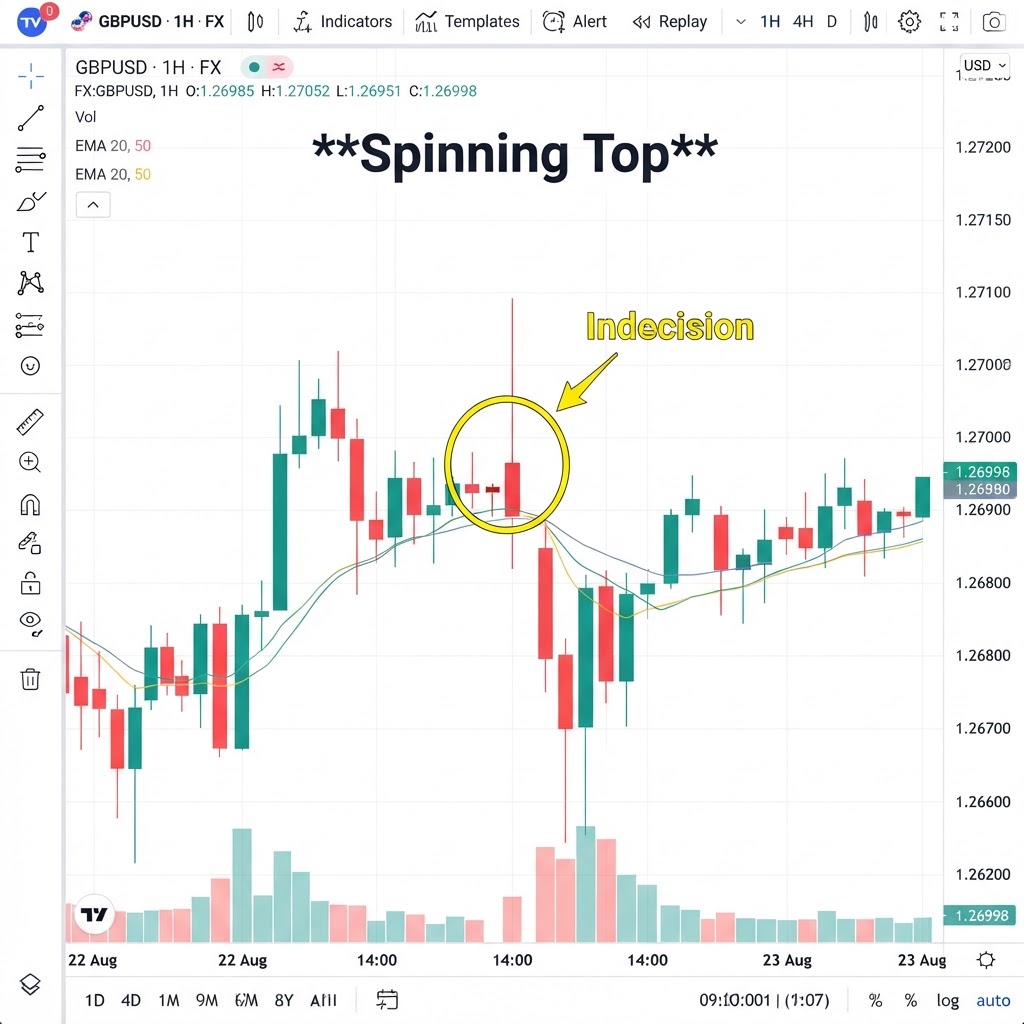
Realistic chart representation
Look for this pattern at the end of a consolidated uptrend, preferably on a key resistance level. Do not trade against the long-term trend.
What is the Spinning Top pattern?
The Spinning Top is a candle with a small body (but not as tiny as a Doji) and similar-length upper and lower shadows. Like the Doji, it represents indecision, but with a slightly less balanced battle between buyers and sellers — both pushed price in both directions but without a net winner.
How do you trade Spinning Top?
Why does the Spinning Top pattern work?
The Spinning Top is a candlestick with a small body (either bullish or bearish) and long shadows on both sides. The body is typically less than 10% of the total candle range, and the upper and lower shadows are of similar length. Like the Doji, the Spinning Top represents indecision — but with slightly more directional bias due to the small body.
The Spinning Top shows that during the session, both buyers and sellers had moments of dominance (the long shadows), but neither could maintain control, and the market closed near the open (the small body). The small body — whether bullish (green) or bearish (red) — shows a slight edge to one side, but the edge is minimal. The long shadows show that both sides made significant attempts but failed to sustain them.
The Spinning Top's significance, like the Doji, depends on context. In a sideways market, it's just noise. In an uptrend, it can signal that buyers are losing momentum — a potential reversal warning. In a downtrend, it can signal that sellers are losing momentum — also a potential reversal warning. The key difference from the Doji is that the Spinning Top has a small body, which shows a slight directional bias, while the Doji has essentially no body.
The Spinning Top is most significant when: (1) it appears after an extended trend, (2) it forms at a key support/resistance level, (3) it has above-average volume, (4) it's confirmed by a reversal candle in the next session. Like the Doji, the Spinning Top is a warning, not a signal — wait for confirmation before entering.
Multiple Spinning Tops in a row (2-3 consecutive) strengthen the indecision signal — they show that the market has been undecided for multiple sessions, which increases the probability of a reversal or breakout. A cluster of Spinning Tops at a key level, followed by a strong directional candle, is a reliable reversal or breakout signal.