Inverted Hammer
The Inverted Hammer has the same shape as the Shooting Star but forms at the end of a downtrend instead of an uptrend.
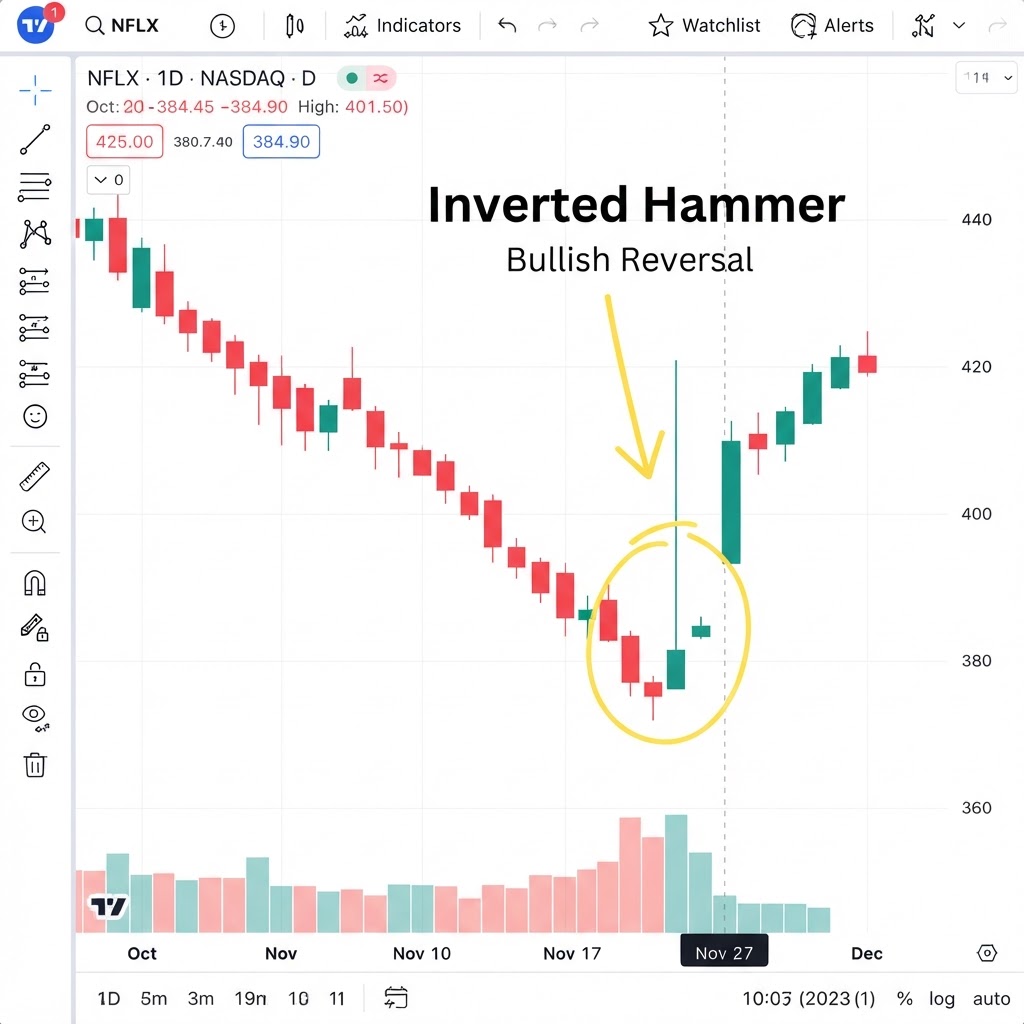
Realistic chart representation
Look for this pattern at the end of a consolidated downtrend, preferably on a key support level. Do not trade against the long-term trend.
What is the Inverted Hammer pattern?
The Inverted Hammer has the same shape as the Shooting Star but forms at the end of a downtrend instead of an uptrend. It has a small body at the bottom and a long upper shadow. Despite the 'bearish' appearance, in a consolidated downtrend context, it signals an attempt by buyers to push price upward. It requires mandatory confirmation in the next candle.
How do you trade Inverted Hammer?
Why does the Inverted Hammer pattern work?
The Inverted Hammer is a bullish reversal pattern that appears at the end of a downtrend. Visually, it's the mirror image of the Hammer: a small body at the bottom of the candle with a long upper shadow (at least 2x the body). The lower shadow is minimal or absent. The pattern indicates that buyers attempted to push price higher during the session but were pushed back by sellers — however, the fact that buyers showed enough strength to create a long upper shadow is a signal that bearish pressure is weakening.
The Inverted Hammer is less reliable than the standard Hammer because the close is at the low of the session, which means sellers still controlled the final price. The long upper shadow shows buyer ambition, but the close shows they didn't succeed. This is why confirmation is absolutely critical — the next candle must close above the Inverted Hammer's body to validate the signal. Without confirmation, the Inverted Hammer is just an alert, not an action signal.
The pattern is more significant when: (1) the upper shadow is very long (3x+ the body), (2) it forms on a key support level, (3) volume is above average, (4) it's preceded by a clear downtrend. On low timeframes, the Inverted Hammer generates many false signals and should be avoided. On Daily and Weekly, especially at major support zones, it can mark the first sign of a significant reversal.