Harami
The Harami (from Japanese 'pregnant') is a two-candle pattern where the second, smaller candle is completely contained within the body of the first, larger one.
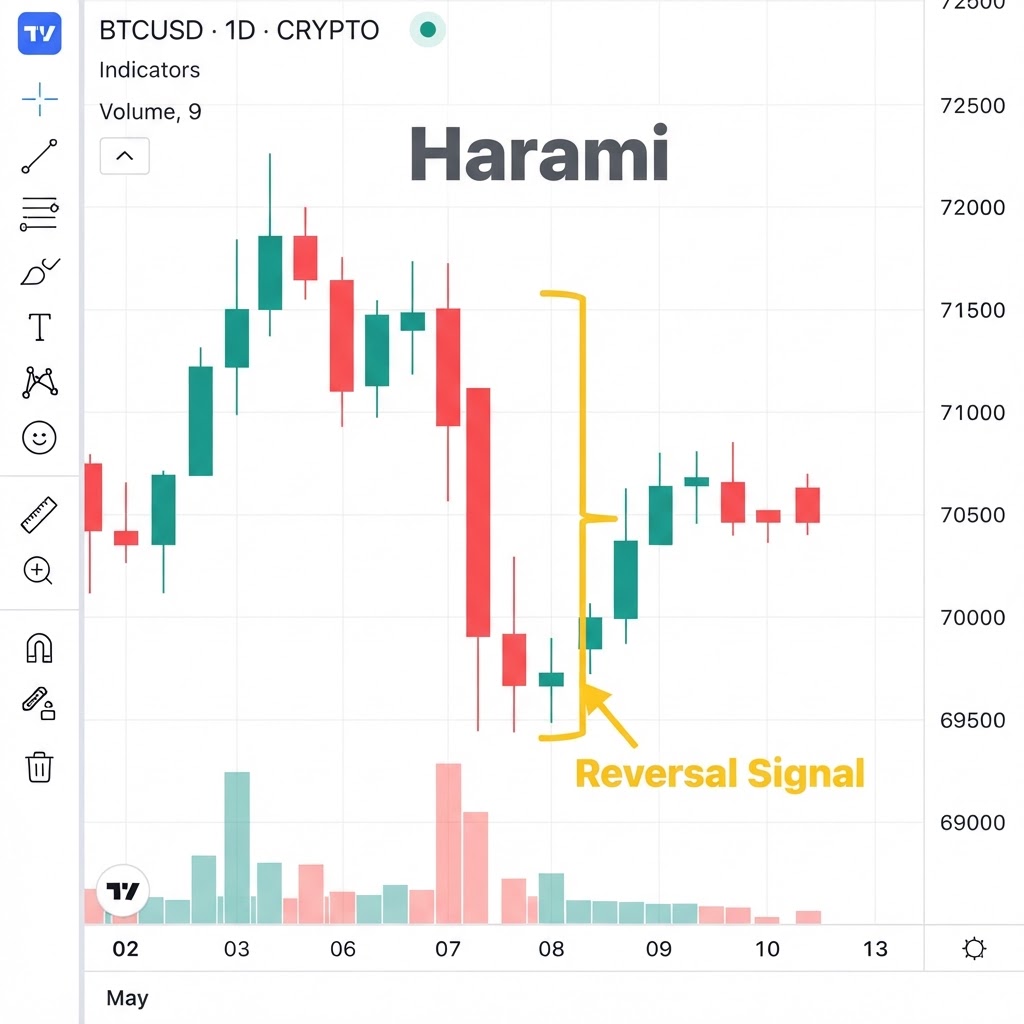
Realistic chart representation
Look for this pattern at the end of a consolidated uptrend, preferably on a key resistance level. Do not trade against the long-term trend.
What is the Harami pattern?
The Harami (from Japanese 'pregnant') is a two-candle pattern where the second, smaller candle is completely contained within the body of the first, larger one. It's the conceptual opposite of the Engulfing: instead of an overpowering, it represents a sudden drop in volatility and conviction after a decisive move, signaling possible indecision and direction change.
How do you trade Harami?
Why does the Harami pattern work?
The Harami is a two-candle reversal pattern. The word 'Harami' means 'pregnant' in Japanese, and the pattern's shape explains the name: a large first candle (the 'mother') contains a smaller second candle (the 'baby') within its body. The second candle's body must be completely within the first candle's body — shadows can extend beyond, but the body must be contained.
There are two types: (1) Bullish Harami — a large bearish candle (first) followed by a small bullish candle (second) contained within the bearish body. It appears at the end of a downtrend and signals a potential bullish reversal. (2) Bearish Harami — a large bullish candle (first) followed by a small bearish candle (second) contained within the bullish body. It appears at the end of an uptrend and signals a potential bearish reversal.
The Harami's message is one of sudden indecision after a strong move. The first candle shows strong conviction in one direction (large body). The second candle shows that the conviction has suddenly evaporated — the small body indicates indecision. This sudden shift from conviction to indecision is the reversal warning. The Harami is not as strong as the Engulfing pattern — it's a moderate signal that benefits from confirmation.
A special variant is the 'Harami Cross' — where the second candle is a Doji instead of a small body. The Harami Cross is more powerful because the Doji shows complete indecision, making the reversal signal stronger. The Harami Cross at a key support/resistance level is a particularly reliable reversal signal.
The Harami is most significant when: (1) the first candle is very large (strong conviction), (2) the second candle is very small (strong indecision), (3) it forms at a key support/resistance level, (4) it's confirmed by a reversal candle in the next session. Volume should be higher on the first candle and lower on the second — this volume pattern confirms the shift from conviction to indecision.