OTE (Optimal Trade Entry)
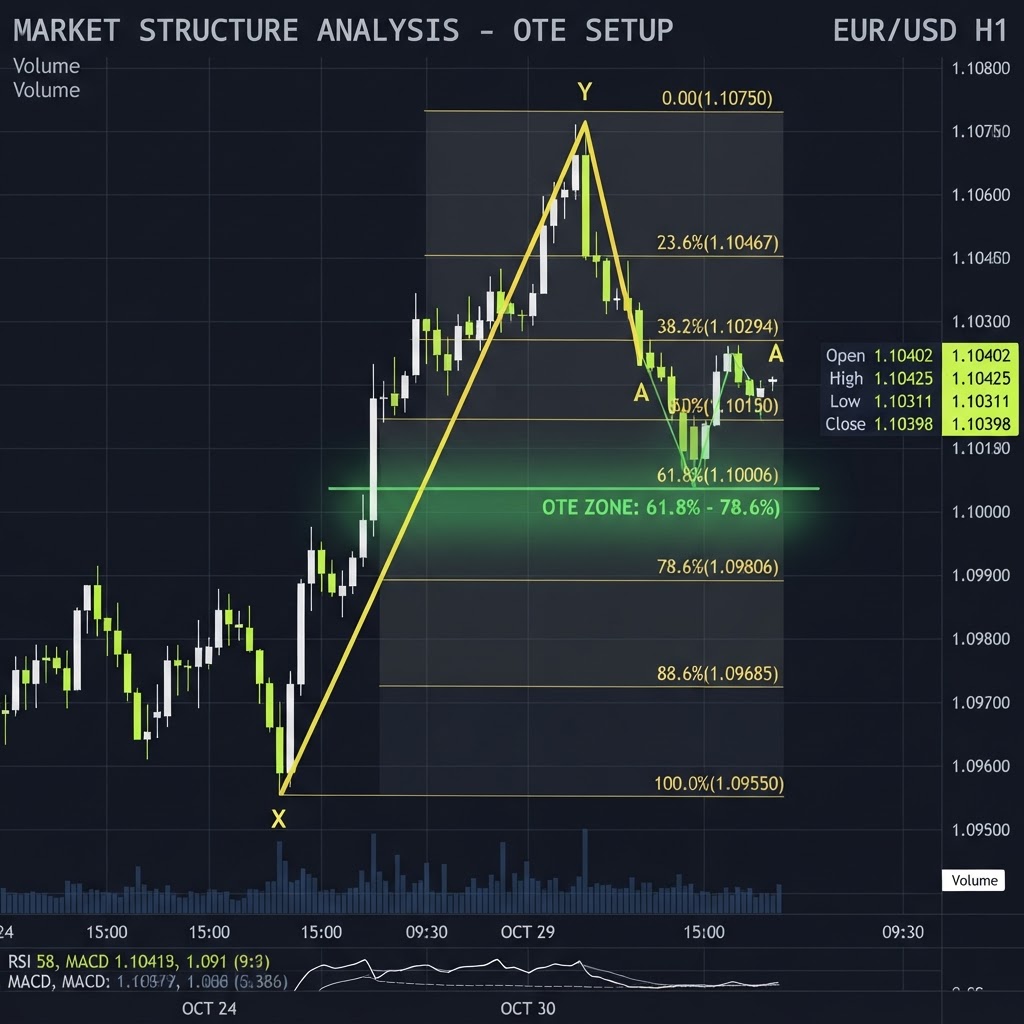
Institutional Thesis
The Optimal Trade Entry (OTE) is the ICT formalization of the empirical finding, supported by decades of Fibonacci retracement statistics, that institutional order flow concentrates in the 62-79% retracement zone of a prior impulse. This is not numerology — it is the zone where the risk/reward ratio of a continuation entry is mathematically optimal: the stop is tight (just beyond the 79% level or the swing origin), the target is the full extension of the prior impulse, and the probability of continuation is highest because 62% is the 'golden ratio' retracement at which trend-following algorithms and institutional desks tend to re-engage. The OTE is a quantitative framework, not a pattern.
Technical Definition
The OTE is the price band between the 62% and 79% Fibonacci retracement levels of the most recent significant impulse. The 'sweet spot' within the OTE is the 70.5% level. The zone is drawn from the origin of the impulse (swing low for a bullish impulse, swing high for a bearish impulse) to the extreme of the impulse (the new high or low). Entry is sought within this band, not at a single price level.
Order-Flow Microstructure
Why 62-79%? In trend-following systems, the 62% retracement (the 'golden pocket') is the level at which institutional algos are programmed to test for continuation — if price holds 62%, the trend is intact; if 79% breaks, the trend is likely reversing. By concentrating entries in this band, institutions achieve the tightest stop placement relative to the largest potential target. An entry at 62% with a stop at the swing origin risks approximately 38% of the impulse distance; the target at the 100% extension (or the next liquidity pool) offers 62%+ of the impulse distance — a baseline R/R of 1:1.6 before any confluence. At 79%, the stop is tighter (21% risk) and R/R improves to 1:3+. This asymmetry is why the zone is 'optimal.'
Identification Framework
1) Identify a clean, impulsive move (displacement-grade) that broke structure. 2) Draw the Fibonacci from the impulse origin to the impulse extreme. 3) Mark the 62% and 79% levels — this band is the OTE. 4) Wait for price to retrace into the band. Do not anticipate — let price come to the zone. 5) Within the OTE, look for a lower-timeframe confirmation: an OB, an FVG, or a micro-ChoCH. The OTE is the 'where'; the confirmation is the 'when.' The most reliable OTE setups occur on higher-timeframe impulses (4H or Daily) where institutional order flow is densest.
Confluence Architecture
OTE is a location filter, not a standalone entry. It becomes a trade when it coincides with: (1) a higher-timeframe OB or FVG within the same price band — the OTE provides the Fibonacci logic, the OB/FVG provides the order-flow logic; (2) a Premium/Discount alignment — a bullish OTE in the Discount half of a higher-timeframe range is higher-probability; (3) a liquidity pool beyond the 79% level — if price sweeps liquidity just beyond the OTE before reversing, the entry is even stronger; (4) a Killzone timing — OTE completions during London or NY opens carry institutional volume. The full stack (OTE + OB + FVG + Premium/Discount + Killzone) is the institutional A+ setup.
Institutional Execution Model
When price enters the OTE band, drop to a lower timeframe (e.g., from 4H to 15m or 1m). Wait for a structure shift (ChoCH) in the expected continuation direction. Entry is on the ChoCH confirmation, stop is beyond the 79% level (or the impulse origin for maximum safety), and the first target is the impulse extreme (100% retracement of the pullback). The second target is the next opposing liquidity pool or a measured-move extension (1.272 or 1.618 of the impulse). Scale in: enter 50% of the position at 70.5%, add 30% at 62%, and 20% at 79% if price extends deeper. This averaging lowers the cost basis while keeping risk bounded by the stop beyond 79%.
Risk Management Framework
OTE trades offer inherently favorable R/R (typically 1:2 to 1:4) because the stop is tight relative to the target. Risk 0.75-1.25% per trade. If price closes beyond the 79% level on the timeframe where the OTE was drawn, the setup is invalidated — the retracement has exceeded the zone of institutional re-engagement, and the trend is likely reversing rather than continuing. Do not move the stop to 'give it room'; the OTE's edge is its precision, and widening the stop destroys the R/R that makes it optimal. Scale out at logical targets and trail the remainder with structure.
The institutional operator deploys OTE (Optimal Trade Entry) only when the full confluence stack is present — structure, order-flow imbalance, value alignment, and Killzone timing. The edge is not the pattern itself; it is the convergence of independent confirmations that collectively reduce the false-positive rate to acceptable levels. Trade the process, not the outcome.
OTE (Optimal Trade Entry) — Test your knowledge
Sign in to take the quiz
Quizzes are reserved for registered users. Create a free account to test your knowledge, track your progress and save your results to your personal profile.
Weekly market setups, new guides and AI insights. Free, zero spam.