Order Block
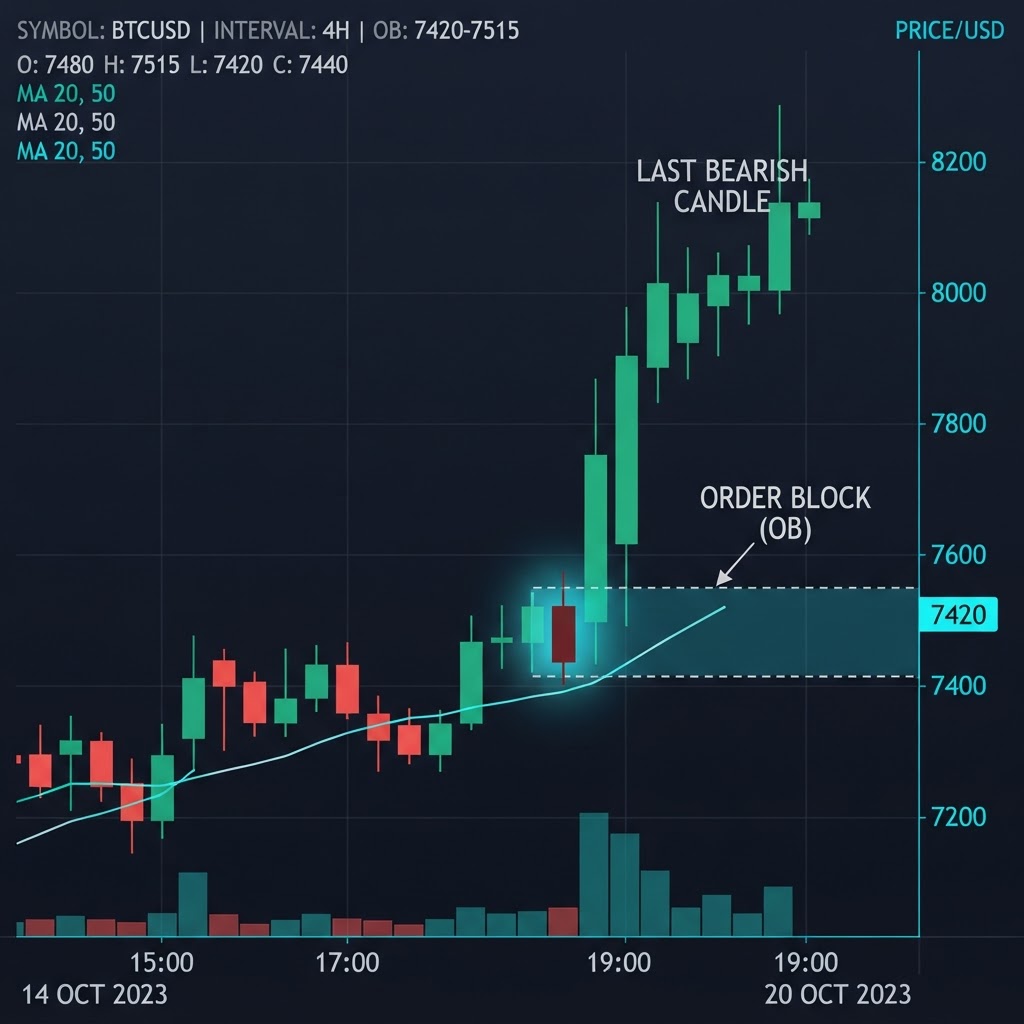
Institutional Thesis
The Order Block (OB) concept is grounded in the academic literature on institutional order execution and market impact. Almgren & Chriss (2000) demonstrated that institutions cannot execute large orders in a single transaction without moving price adversely against themselves; they must fragment orders across time and price levels. The candle (or cluster of candles) that immediately precedes a displacement move is the observable footprint of this fragmentation — the last price level at which the institutional participant built a directional position before the market repriced. The OB is therefore not a support/resistance line in the classical sense; it is a proxy for unexecuted residual interest from a large player whose order flow was materially significant relative to available liquidity.
Technical Definition
An Order Block is the last counter-trend candle (or tight cluster) immediately preceding an impulsive, displacement-grade move that breaks market structure. A bullish OB is the last bearish candle before a bullish displacement; a bearish OB is the last bullish candle before a bearish displacement. The zone is defined by the high-low range of that candle, not merely its close. Validity requires the displacement to generate a Fair Value Gap and/or a clear Break of Structure — without displacement, the candle is noise, not an OB.
Order-Flow Microstructure
When an institution needs to accumulate a long position, it faces a liquidity problem: there are insufficient resting sell orders at the current price to fill its entire order. The solution is to engineer a downward move — often via a liquidity sweep below prior lows — that triggers retail stop-loss orders (which are sell orders) and passively fills the institution's buy order at depressed prices. The candle that absorbs this flow becomes the bullish OB. The residual, unexecuted portion of the institutional order remains as resting interest at that level; when price returns (mitigates) the OB, the institution completes or extends its position, producing a reaction. This is why OBs 'work' — they represent real, unfilled institutional intent, not pattern mysticism.
Identification Framework
1) Locate a displacement move: a candle or sequence with range >= 2x the prior 20-period ATR and a close near its extreme. 2) Identify the last counter-trend candle before the displacement — this is the OB candidate. 3) Confirm the OB contains or is adjacent to a Fair Value Gap (the displacement must leave an imbalance). 4) Verify the displacement broke structure (BOS) — an OB without a BOS is a low-probability zone. 5) Rank OBs by timeframe hierarchy: a Daily OB outweighs a 15m OB. The most tradable OBs are those that have not yet been mitigated (price has not returned).
Confluence Architecture
A naked OB carries approximately 50-55% reaction probability. Confluence stacking raises this materially: OB + FVG in the same zone -> 70-75%; OB + FVG + a higher-timeframe Premium/Discount alignment -> 78-82%; OB + FVG + OTE (62-79% retracement) + a liquidity pool above/below -> 82-88%. The institutional operator does not trade single signals — they trade confluence clusters where multiple independent order-flow proxies converge on the same price level. This is the quantitative edge: each additional independent confirmation reduces the false-positive rate geometrically.
Institutional Execution Model
Map the OB zone on the higher timeframe; drop to a lower timeframe for execution. The entry trigger is a lower-timeframe ChoCH in the expected direction once price enters the OB zone — this confirms institutional re-engagement rather than a continuation through. Stop loss is placed beyond the OB extreme plus a volatility buffer (0.25x ATR). The first target is the opposing liquidity pool (the nearest equal highs/lows where trapped traders sit); the second target is the origin of the displacement. Minimum R/R: 1:2. Scale out 50% at the first liquidity pool and trail the remainder using lower-timeframe structure breaks.
Risk Management Framework
Position size is determined by the distance from entry to stop, never by a fixed lot size. Risk per trade is capped at 0.5-1% of equity for OB trades in isolation, but can be elevated to 1.5% when full confluence (OB + FVG + OTE + Premium/Discount) is present, because the expectancy of the confluence cluster justifies the additional risk. If price closes beyond the OB extreme on the higher timeframe (not merely wicks through), the thesis is invalidated — exit immediately and do not average down. The institutional operator treats OB invalidation as a signal that residual order flow has been consumed, not as a 'discount' to add risk.
The institutional operator deploys Order Block only when the full confluence stack is present — structure, order-flow imbalance, value alignment, and Killzone timing. The edge is not the pattern itself; it is the convergence of independent confirmations that collectively reduce the false-positive rate to acceptable levels. Trade the process, not the outcome.
Order Block — Test your knowledge
Sign in to take the quiz
Quizzes are reserved for registered users. Create a free account to test your knowledge, track your progress and save your results to your personal profile.
Weekly market setups, new guides and AI insights. Free, zero spam.