Liquidity
Institutional Thesis
The ICT liquidity model formalizes the observation, well-documented in market microstructure research (Lyons 2001, 'The Microstructure Approach to Exchange Rates'), that institutional order execution depends on the availability of contra-side liquidity. Retail stop-loss orders are the largest and most predictable source of this liquidity. Because retail traders cluster stops above obvious highs and below obvious lows — and because this clustering is quantifiable from publicly available price structure — institutions can identify and exploit these pools. The 'liquidity sweep' is the mechanism by which a large player triggers these stops to fill its own contra-side order at favorable prices.
Technical Definition
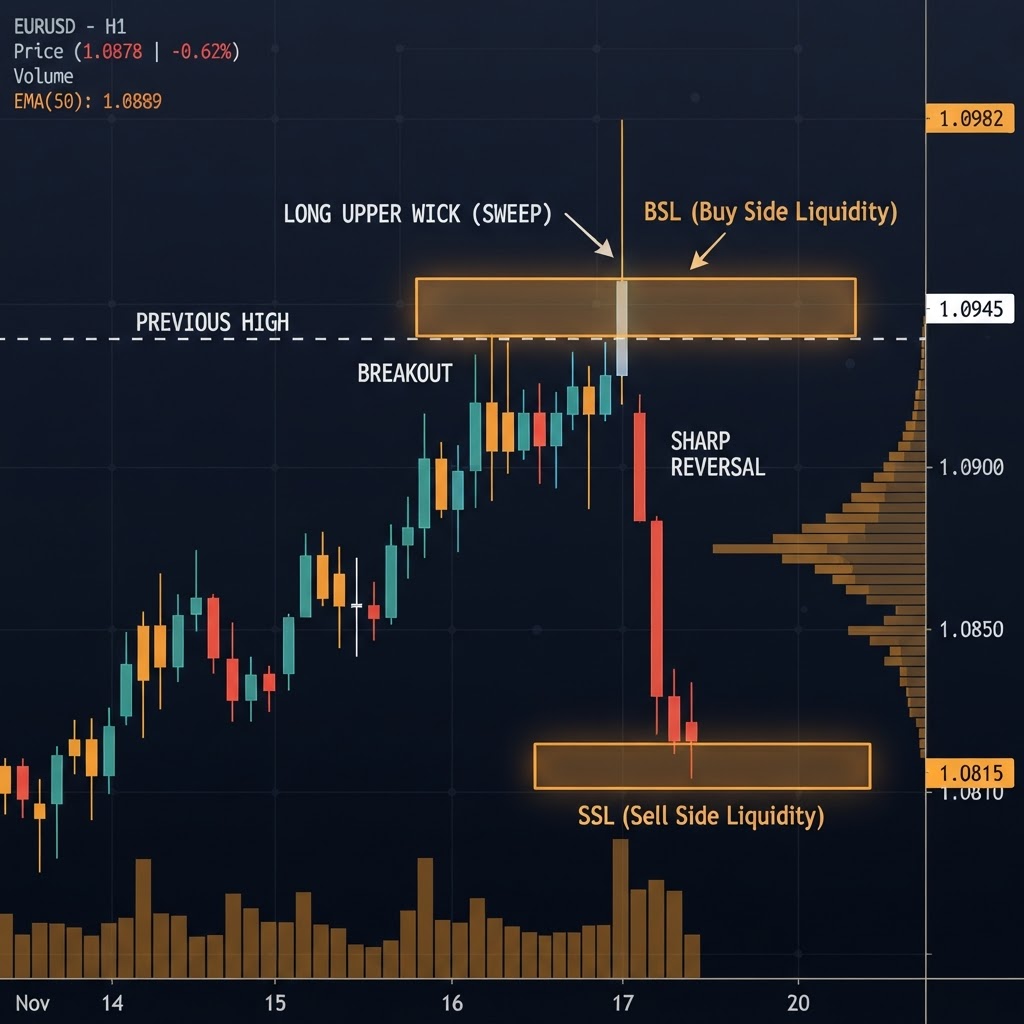
Liquidity refers to resting orders (predominantly stop-losses and pending break-out orders) concentrated at predictable price levels: above equal highs (buy-side liquidity, BSL), below equal lows (sell-side liquidity, SSL), at round numbers, and at prior session highs/lows. A Liquidity Sweep (or 'raid') is a deliberate, rapid price excursion beyond one of these levels that triggers the resting orders, absorbs them into institutional flow, and then reverses. The sweep is the mechanism; the reversal is the opportunity.
Order-Flow Microstructure
When an institution needs to build a short position, it requires buy orders to sell into. Buy-side liquidity (stops above highs) provides exactly this. The institution pushes price above the high — triggering the stops, which are market sell orders that the institution absorbs as the buyer, filling its short at the swept high. Once the pool is consumed, price reverses because there is no remaining buy-side flow to sustain the breakout. This is why sweeps leave long wicks: the wick is the visible record of the liquidity grab. The pattern is symmetric for sell-side liquidity and long accumulation. Equal highs and lows (where multiple touches create the appearance of a 'wall') are the highest-liquidity pools because they attract the maximum concentration of breakout and stop orders.
Identification Framework
Map liquidity pools on the chart: (1) Equal highs — price tapped the same high two or more times without breaking it (BSL). (2) Equal lows — symmetric SSL. (3) Prior session highs/lows — the Asian high/low are the first targets of the London session. (4) Round numbers (e.g., EURUSD 1.1000, BTC 50,000). (5) Order Block extremes — stops cluster just beyond OBs. Prioritize pools that have not yet been swept — 'fresh' liquidity is more valuable than already-mitigated levels. The highest-value sweeps occur at the intersection of multiple pool types (e.g., an equal high that coincides with a round number and a prior session high).
Confluence Architecture
A liquidity sweep is the most powerful when it coincides with: (1) a Killzone open — London and NY sweeps carry institutional volume; (2) an OB or FVG just beyond the swept level — the reversal has a structural reason to bounce; (3) a Premium/Discount alignment — a sweep in the Discount zone for a long reversal is higher-probability than a sweep in the Premium zone; (4) a higher-timeframe OTE completion. The highest-value ICT setup is a higher-timeframe liquidity sweep that returns to a lower-timeframe OB+FVG+OTE confluence. This confluence stack is the institutional playbook.
Institutional Execution Model
Do not trade the sweep in real-time — it is too fast and you will be on the wrong side. Wait for the sweep to complete (price has wicked beyond the level and returned below/above it), then wait for a lower-timeframe ChoCH confirming the reversal direction. Entry is on the ChoCH, stop is beyond the sweep extreme (the wick high/low), and target is the opposing liquidity pool. If the sweep was of the Asian high during London, the target is the Asian low. R/R on clean sweeps is typically 1:3 to 1:5. The operator must be patient: the best sweeps occur in the first 1-2 hours of London and NY, not randomly throughout the day.
Risk Management Framework
Sweep-reversal trades are high-conviction setups when confirmed by structure. Risk 1-1.5% per trade. The stop must be placed beyond the sweep wick — if price returns beyond the wick, the sweep was not a true liquidity grab but a genuine breakout, and the thesis is dead. Never widen the stop to accommodate a losing sweep trade; the setup is binary (it either works immediately or it doesn't). Scale out 50% at the first internal liquidity pool and trail the remainder using 1m/5m structure breaks. The institutional operator does not hold sweep-reversal trades overnight unless the higher-timeframe structure supports it.
The institutional operator deploys Liquidity only when the full confluence stack is present — structure, order-flow imbalance, value alignment, and Killzone timing. The edge is not the pattern itself; it is the convergence of independent confirmations that collectively reduce the false-positive rate to acceptable levels. Trade the process, not the outcome.
Liquidity — Test your knowledge
Sign in to take the quiz
Quizzes are reserved for registered users. Create a free account to test your knowledge, track your progress and save your results to your personal profile.
Weekly market setups, new guides and AI insights. Free, zero spam.