Killzones
Institutional Thesis
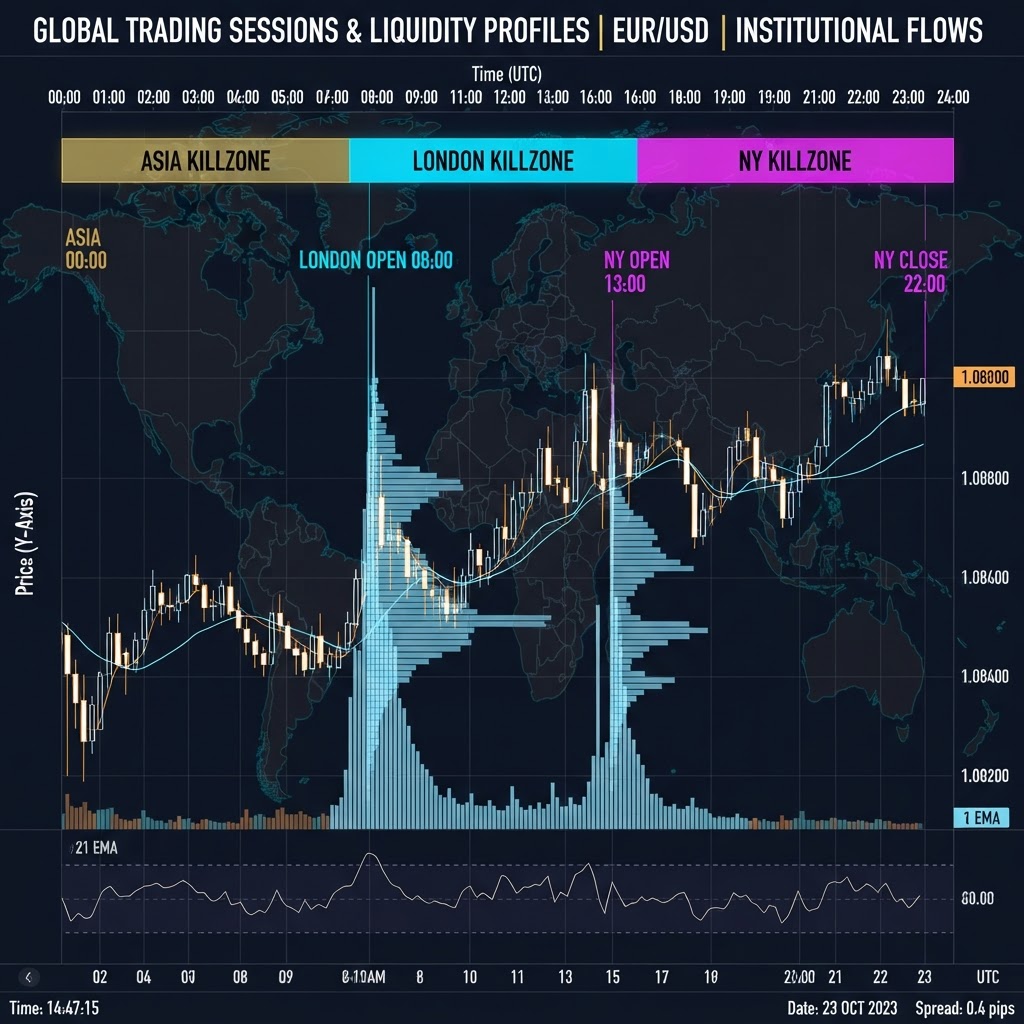
The Killzone concept is grounded in the empirical observation, documented in FX microstructure literature (Evans & Lyons 2002), that institutional order flow is not uniformly distributed across the 24-hour cycle but concentrates at session opens when banks, hedge funds, and algorithmic desks initiate and rebalance positions. The London and New York opens account for a disproportionate share of daily volume and volatility. By restricting execution to these windows, the ICT operator aligns entries with the times when institutional flow is densest, signal-to-noise ratio is highest, and the probability that a structural signal (OB, FVG, sweep) reflects genuine institutional intent rather than illiquid noise is maximized.
Technical Definition
Killzones are specific time windows corresponding to the opening hours of major global trading sessions: Asian Killzone (20:00-00:00 EST), London Killzone (02:00-05:00 EST), New York Killzone (07:00-10:00 EST), and London Close (10:00-12:00 EST). Each window has distinct volatility and order-flow characteristics. The term 'killzone' reflects the premise that these are the windows where the highest-probability, highest-impact trades are found — and where trading outside them tends to 'kill' accounts through low-probability noise trades.
Order-Flow Microstructure
The global FX market is a sequence of overlapping bank sessions. The Asian session (Tokyo, Singapore) builds a range — it is typically the lowest-volatility window because Asian institutional flow is thinner than European/American. The London open is the most consequential: European banks (which hold the largest share of global FX flow) initiate positions, algorithmic desks rebalance, and the Asian range is typically swept or broken. The New York open adds American institutional flow on top of the London direction, often accelerating the move. The London Close is a transition window where European positions are squared, creating reversals or consolidations. The inter-session dead zone (late Asia, pre-London) is illiquid: spreads widen, order flow is thin, and structural signals are unreliable — this is the window the operator avoids.
Identification Framework
Map the daily session cycle: (1) Asian range: mark the high and low of the 20:00-00:00 EST window — these are the liquidity targets for London. (2) London open: watch for a sweep of the Asian high or low within the first 1-2 hours — this is the Judas Swing / liquidity grab. (3) London continuation: the true directional move typically emerges after the sweep, between 02:00-05:00 EST. (4) NY open: watch for continuation or reversal of the London move at 07:00-10:00 EST. (5) Avoid the 12:00-14:00 EST dead zone and the late Asian session. The operator does not trade every minute of a Killzone — they prepare during Asia, hunt the sweep at London open, and execute the continuation during the first 1-3 hours of London and NY.
Confluence Architecture
Killzones are a timing filter, not a standalone signal. Their power is in confluence with structure: a liquidity sweep of the Asian high during the London open, followed by a ChoCH and BOS, is the canonical ICT daily setup. An OB or FVG that forms during a Killzone is higher-quality than one that forms in the dead zone, because the order flow behind it is institutional. The highest-probability trades occur when a higher-timeframe structural level (OB, FVG, OTE) is reached during a Killzone open — the timing and the structure align. Avoid economic news releases within Killzones (NFP, CPI, FOMC) unless specifically trading the news reaction, as these events distort normal order-flow patterns.
Institutional Execution Model
The institutional daily routine: (1) Pre-London (01:00 EST): mark the Asian range high/low, identify higher-timeframe OB/FVG/OTE levels, and define directional bias from the higher-timeframe structure. (2) London open (02:00 EST): watch for the Asian range sweep. If price sweeps the Asian high and reverses (bearish ChoCH on 5m/15m), seek a short. If it sweeps the low and reverses, seek a long. (3) Execution: enter on the lower-timeframe ChoCH+BOS confirmation, with stop beyond the sweep extreme. (4) NY open (07:00 EST): if London established a direction, look for a pullback to an intraday OB/FVG for a continuation entry. If London was range-bound, watch for the NY sweep of the London high/low. (5) Scale out at opposing intraday liquidity pools.
Risk Management Framework
Killzone trades benefit from institutional volume, which means fills are cleaner, slippage is lower, and stop runs are more predictable. Risk 0.75-1.25% per Killzone trade. The critical risk management rule: do not trade outside Killzones. The dead zone produces structural signals that look identical to Killzone signals but are generated by thin, illiquid flow — they fail at a much higher rate. If no setup forms during the London or NY Killzone, the operator sits flat — no trade is a position. Forcing trades outside Killzones is the primary cause of drawdown in ICT-based strategies, because the signal-to-noise ratio collapses when institutional flow is absent.
The institutional operator deploys Killzones only when the full confluence stack is present — structure, order-flow imbalance, value alignment, and Killzone timing. The edge is not the pattern itself; it is the convergence of independent confirmations that collectively reduce the false-positive rate to acceptable levels. Trade the process, not the outcome.
Killzones — Test your knowledge
Sign in to take the quiz
Quizzes are reserved for registered users. Create a free account to test your knowledge, track your progress and save your results to your personal profile.
Weekly market setups, new guides and AI insights. Free, zero spam.