Fair Value Gap (FVG)
Institutional Thesis
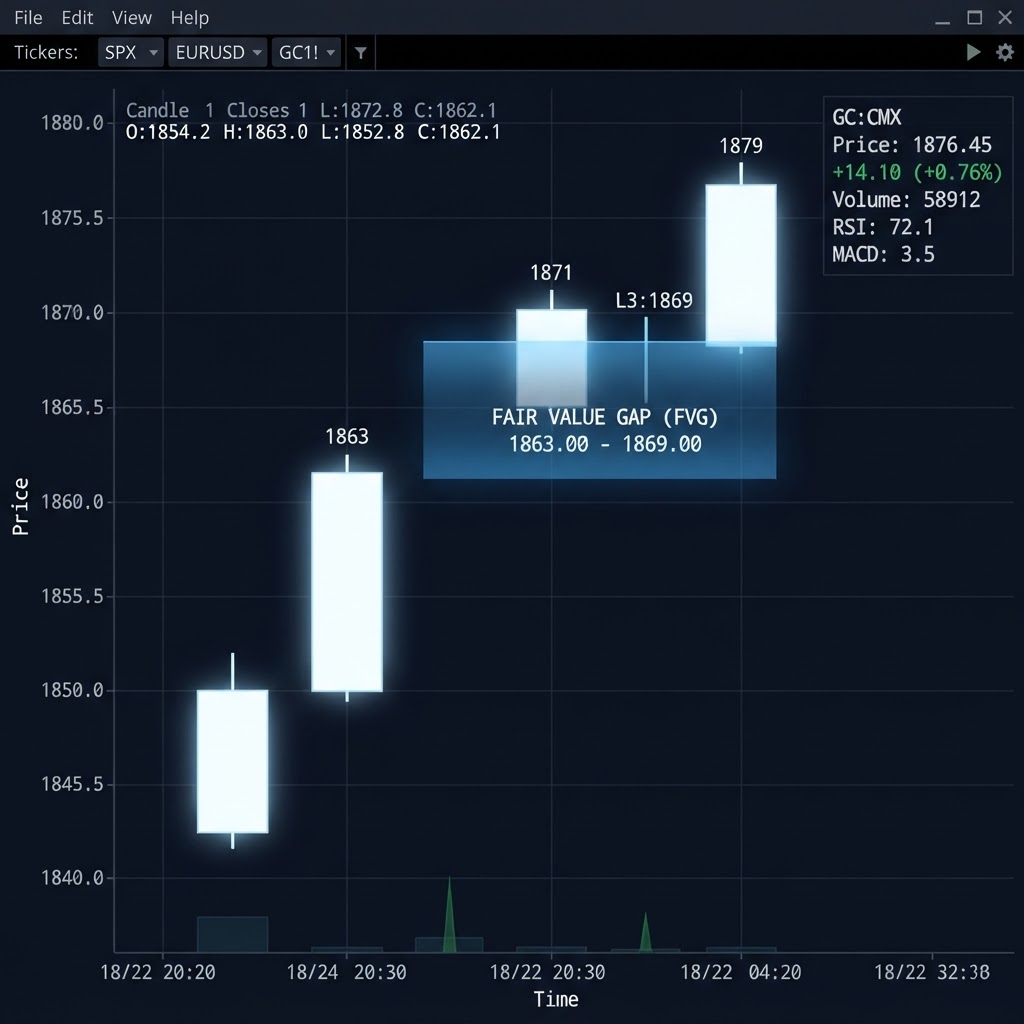
The Fair Value Gap (FVG) is the ICT nomenclature for what academic microstructure literature calls an 'imbalance' or 'inefficiency' — a price interval that was traversed without two-sided trade. In efficient-market theory, price discovery is continuous; in practice, large order flow creates discontinuities where the order book is swept faster than it repopulates. The FVG marks these discontinuities. The empirical observation that price returns to fill FVGs reflects the market's tendency to re-establish two-sided liquidity at prices where it was absent — a form of price discovery completion rather than a mystical magnetism.
Technical Definition
A Fair Value Gap is a three-candle formation in which the wick of candle 1 and the wick of candle 3 do not overlap, leaving an uncovered price interval between them. In a bullish FVG, the high of candle 1 is below the low of candle 3; in a bearish FVG, the low of candle 1 is above the high of candle 3. The gap is the price band between those two extremes. It represents a zone of one-sided order flow — no opposing orders were filled within it during the displacement.
Order-Flow Microstructure
An FVG forms when aggressive, directional order flow consumes all resting liquidity within a price band faster than new limit orders repopulate it. The result is a 'void' in the order book. Market makers and algorithmic participants are incentivized to return price to this void because: (1) it represents uncontested price space where they can fill contra-side inventory cheaply, and (2) retail stop-loss orders frequently rest just beyond the FVG, providing the liquidity needed to close the gap profitably. The fill rate of FVGs across liquid markets is empirically high (>80% on intraday timeframes for major FX pairs), which is why the concept has quantitative validity rather than being merely anecdotal.
Identification Framework
Scan for three-candle sequences where the middle candle is a displacement candle (range >= 1.5x prior average). Check the overlap between candle 1's extreme (high for bullish sequence, low for bearish) and candle 3's opposite extreme. If there is a gap of at least a few pips/ticks, an FVG exists. Mark the zone. Prioritize FVGs formed during Killzone hours (London/NY opens) — these carry institutional order flow and fill at higher rates than FVGs formed in the illiquid Asian dead zone. Unmitigated FVGs (never re-tested) on higher timeframes are the highest-value targets.
Confluence Architecture
FVGs gain power through convergence. A Daily FVG that aligns with a 4H FVG and a 1H FVG at the same price level is a 'confluence stack' — the probability of a reaction at that zone approaches 85-90%. FVG + OB confluence is the foundational ICT setup: when the displacement that created the FVG originated from an OB, the zone represents both residual institutional interest (OB) and order-book imbalance (FVG). FVG + a 70.5% Fibonacci level (the 'OTE sweet spot') adds a third independent variable. The operator trades the stack, never the single FVG.
Institutional Execution Model
Never enter blindly into an FVG — it is a target zone, not an entry signal. Wait for price to return to the FVG, then seek a lower-timeframe confirmation: a 1m or 5m ChoCH, a rejection wick, or a micro-liquidity sweep beyond the FVG edge followed by reversal. Entry is on the confirmation, stop is beyond the FVG's extreme (the level beyond which the gap is 'broken' rather than 'filled'), and target is the next opposing liquidity pool or the origin of the displacement that created the gap. Partial fills (price entering only 50% of the FVG) are common and still tradable — the 50% level is often the reaction point within the gap.
Risk Management Framework
FVG trades carry lower individual probability than OB trades (~55-65%) but offer superior R/R because the stop is tight (just beyond the gap) and the target is the full displacement distance. Risk 0.5-0.75% per FVG trade. If price closes beyond the FVG on the originating timeframe, the gap has been 'consumed' and the setup is void — do not re-enter the same gap. Multi-FVG confluence stacks can justify 1-1.5% risk. The institutional operator treats a broken FVG as a structure signal in the breakout direction, not a failed setup to revenge-trade.
The institutional operator deploys Fair Value Gap (FVG) only when the full confluence stack is present — structure, order-flow imbalance, value alignment, and Killzone timing. The edge is not the pattern itself; it is the convergence of independent confirmations that collectively reduce the false-positive rate to acceptable levels. Trade the process, not the outcome.
Fair Value Gap (FVG) — Test your knowledge
Sign in to take the quiz
Quizzes are reserved for registered users. Create a free account to test your knowledge, track your progress and save your results to your personal profile.
Weekly market setups, new guides and AI insights. Free, zero spam.