Breaker Block
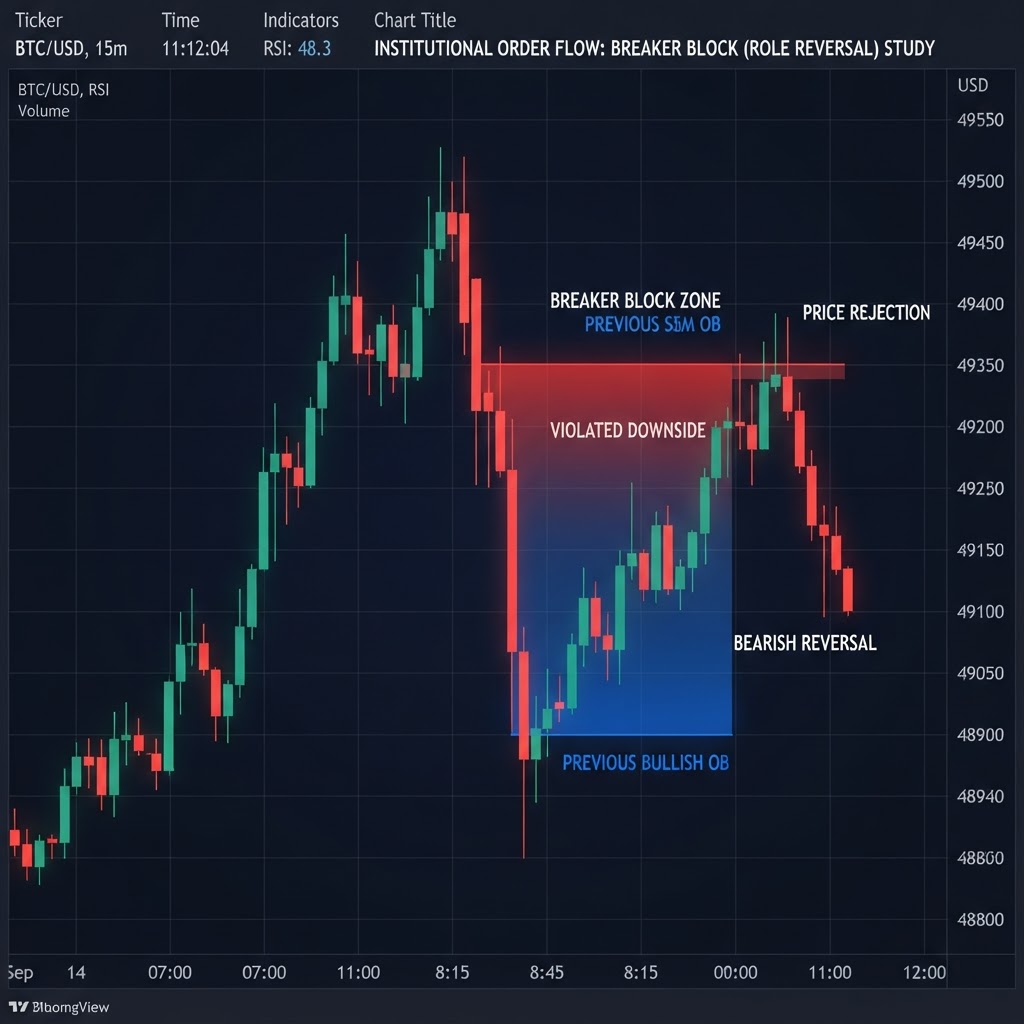
Institutional Thesis
The Breaker Block is the ICT formalization of the classical support/resistance flip, elevated to institutional order-flow logic. When an Order Block is violated — meaning price closes decisively beyond it with a BOS or ChoCH — the institutional orders that created it have been consumed or overwhelmed. The zone does not become irrelevant; it changes role. Traders who entered at the original OB are now trapped in losing positions; their stop-loss orders (which sit just beyond the OB) become resting liquidity at that level. When price returns to the violated OB, the institutional operator uses this trapped liquidity to enter in the new direction. The Breaker is the order-flow rationale for why S/R flips work.
Technical Definition
A Breaker Block is an Order Block that has been violated by a displacement-grade move that broke structure. A bullish OB violated downward becomes a Bearish Breaker (resistance); a bearish OB violated upward becomes a Bullish Breaker (support). The Breaker is the institutional S/R flip: the zone that was support becomes resistance (and vice versa) because the order-flow context has reversed.
Order-Flow Microstructure
When a bullish OB is violated, two things happen: (1) the institutional buyers who built the OB have been overwhelmed by stronger sell-side flow — their residual interest is either exhausted or reversed; (2) retail and algorithmic traders who entered long at the OB now hold losing positions with stop-losses just below the OB. When price returns to the violated OB, these stops provide sell-side liquidity that institutional shorts use to add to or enter positions. The reaction in the new direction is therefore driven by real order flow (trapped stops) rather than by pattern-recognition self-fulfillment. The most powerful Breakers are those preceded by a liquidity sweep: the sweep collects the trend's final liquidity, the OB is violated in the opposite direction, and the Breaker forms at the violated OB — a three-stage institutional reversal pattern.
Identification Framework
1) Identify a prior Order Block that was significant (displacement-grade, created an FVG, broke structure). 2) Confirm it has been violated: price closed beyond the OB extreme with a BOS or ChoCH. The violation must be displacement-grade, not a marginal poke — a weak break does not create a Breaker, it creates ambiguity. 3) Mark the violated OB zone — this is the Breaker. 4) Wait for price to return to the Breaker zone. 5) Seek a lower-timeframe confirmation (ChoCH, rejection wick, micro-sweep) at the zone. The best Breakers are those where the violation was preceded by a liquidity sweep — the sweep + violation + return sequence is the institutional reversal template.
Confluence Architecture
Breakers are powerful because they combine two order-flow dynamics: trapped-trader liquidity at the violated level and the structural role reversal. Confluence enhances this: (1) Breaker + a higher-timeframe Premium/Discount alignment — a Bearish Breaker in the Premium zone is the ideal short location; (2) Breaker + FVG — if the violation created an FVG that the return is filling, the confluence is tighter; (3) Breaker + Killzone timing — Breakers tested at London or NY opens carry institutional reaction flow; (4) Breaker + OTE — if the return to the Breaker coincides with a 62-79% retracement of the violating move, the entry is in the institutional sweet spot. A Breaker that coincides with an equal-highs/lows liquidity pool is the highest-probability Breaker — the zone has both structural and liquidity significance.
Institutional Execution Model
1) Identify the violated OB (the Breaker) on the higher timeframe. 2) Wait for price to return to the zone. 3) Drop to a lower timeframe and wait for a ChoCH in the new direction (the direction of the violation). 4) Entry is on the ChoCH confirmation, stop is beyond the Breaker extreme (the far side of the violated OB), and target is the origin of the violating move or the next opposing liquidity pool. R/R is typically 1:2 to 1:4 because the stop is tight (just beyond the zone) and the target is the full violating-move distance. The operator does not enter at the Breaker on a touch alone — the lower-timeframe ChoCH filters out Breakers that are being consumed rather than respected.
Risk Management Framework
Breaker trades carry higher probability than naked OB trades (~65-75%) because the trapped-trader liquidity provides a structural reason for the reaction. Risk 0.75-1.25% per trade. If price closes beyond the Breaker extreme (the far side), the Breaker has failed — the zone is being consumed rather than respected, and the move is extending. Exit immediately; do not average into a failing Breaker. The institutional operator treats a failed Breaker as a breakout signal in the extending direction, not as a loss to recover. Scale out at logical liquidity targets and trail the remainder with lower-timeframe structure.
The institutional operator deploys Breaker Block only when the full confluence stack is present — structure, order-flow imbalance, value alignment, and Killzone timing. The edge is not the pattern itself; it is the convergence of independent confirmations that collectively reduce the false-positive rate to acceptable levels. Trade the process, not the outcome.
Breaker Block — Test your knowledge
Sign in to take the quiz
Quizzes are reserved for registered users. Create a free account to test your knowledge, track your progress and save your results to your personal profile.
Weekly market setups, new guides and AI insights. Free, zero spam.