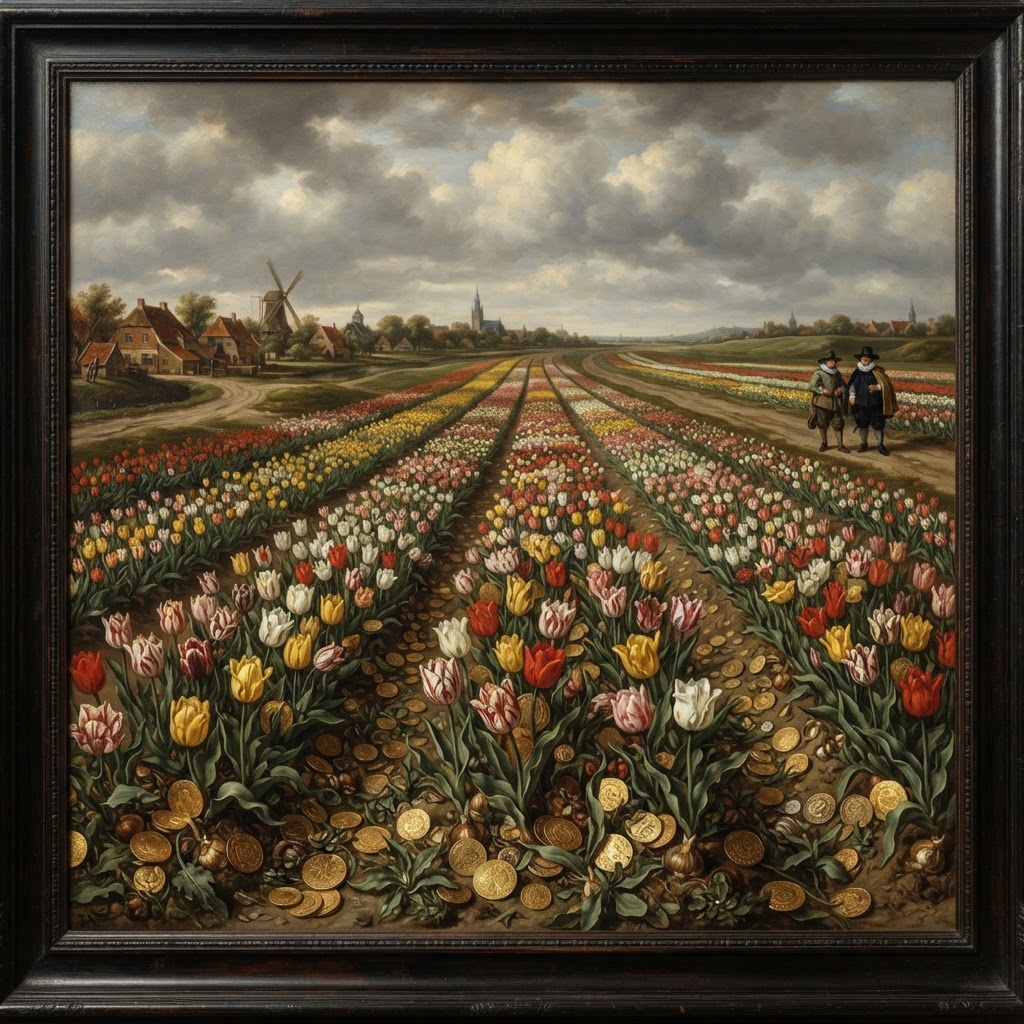
The 1637 Tulip Mania: the first speculative bubble in history
When a flower bulb was worth as much as a house in Amsterdam — and then was worth nothing
In 1637 in the Netherlands, rare tulip bulbs were sold at prices equivalent to entire mansions. In February 1637, the market crashed in a few days. The first documented bubble in history.
When a flower was worth a house
In 17th-century Netherlands, tulips were a status symbol. Wealthy merchants used them to impress guests. Soon a speculative market developed: bulbs could be bought and sold dozens of times before even being planted.
The peak
In February 1637, a single bulb of the Semper Augustus variety was traded for 10,000 florins — the equivalent of a house on an Amsterdam canal. A futures market also developed for bulbs not yet bloomed.
The crash
On February 3, 1637, a bulb auction in Haarlem found no buyers. The news spread rapidly. In a few days, prices crashed 95-99%. Those who had bought at the top were left with bulbs practically worthless.
The proto-modern bubble
What makes the tulip mania universally relevant is that it perfectly reproduces the mechanisms of every subsequent bubble: euphoria, implicit leverage (futures), FOMO, and then panic.
Timeless lessons
- Every bubble has a narrative: tulips were "the future of Dutch wealth." Narratives make the irrational rational.
- The futures market amplifies speculation: the problem wasn't the tulip — it was the structure of forward contracts.
- Mass psychology doesn't change: the same patterns repeat every generation.