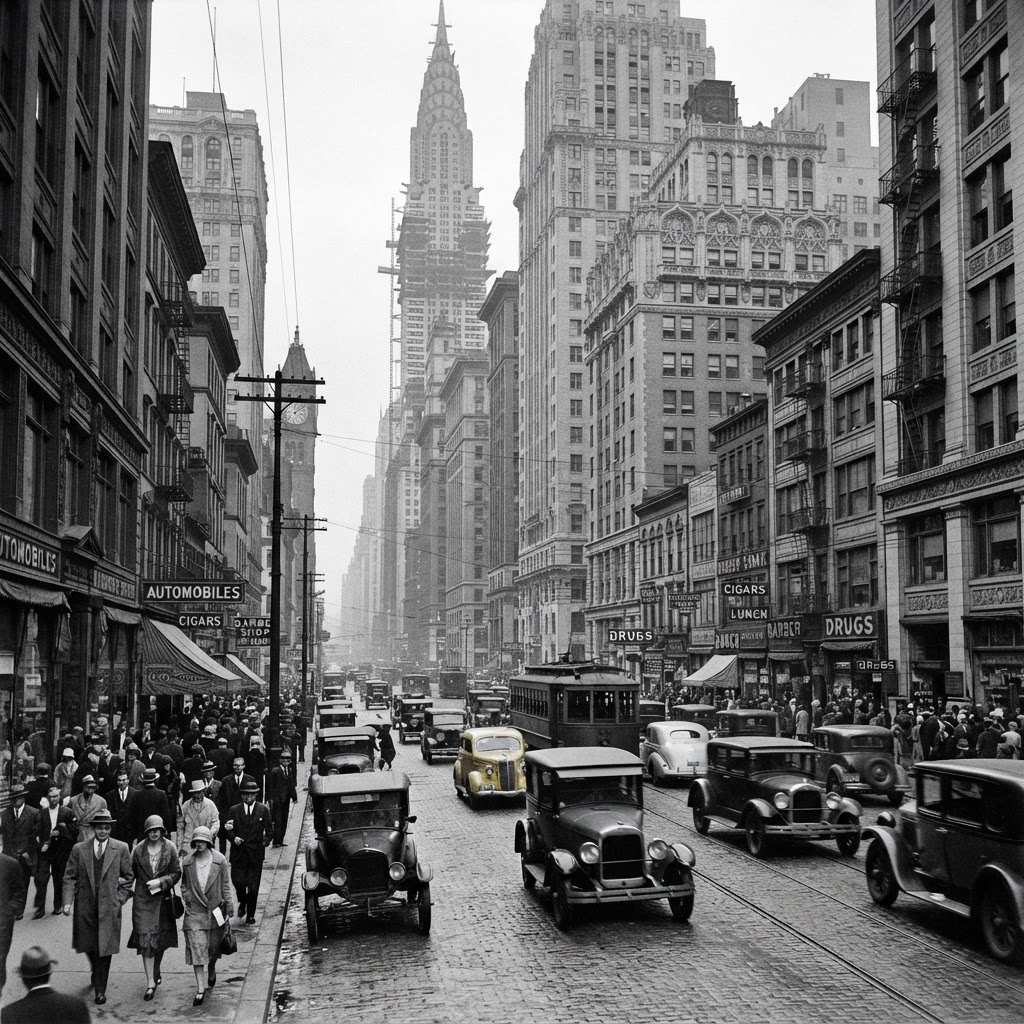
The Roaring Twenties 1920-1929: how the new economy of the '20s fueled the greatest bubble of the 20th century
The story of the speculative euphoria of the '20s — automobiles, radio, cinema, consumerism, and financial leverage that set the stage for 1929
The 1920s saw the emergence of new industries (auto, radio, cinema) and unprecedented stock speculation. The Dow Jones rose 500%. The seeds of the Great Crash were already planted.
The new economy of the 1920s
In 1920, America was different from anything the world had seen before. Automobiles (Ford Model T), radio, sound cinema, appliances — these new technologies were transforming daily life. Wall Street understood before anyone else the implications: General Motors, RCA (Radio Corporation of America), and electric utilities became the hottest stocks of the decade.
10% leverage
The real accelerant of the bubble was leverage: investors could buy stocks with only 10% margin. With $1,000, you could control $10,000 of stock. This leverage enormously amplified both gains and losses.
The American middle class, enriched by the postwar economic boom, threw itself massively into the stock market for the first time in history.
The ignored signals
Already in 1928-1929, some economists warned that prices were disconnected from fundamentals. Average P/E ratios exceeded 30x. Irving Fisher declared in September 1929 that "stocks have reached a permanently high plateau." Three weeks later the Great Crash began.
- "This time is different" is always false: the new technologies of the 1920s were real — the valuations were irrational.
- Leverage amplifies everything — in both directions: 10% margin worked magnificently on the way up and destroyed everything on the way down.
- Bull markets end when easy credit ends: the Fed's tightening in 1928-29 was the catalyst for the crash.