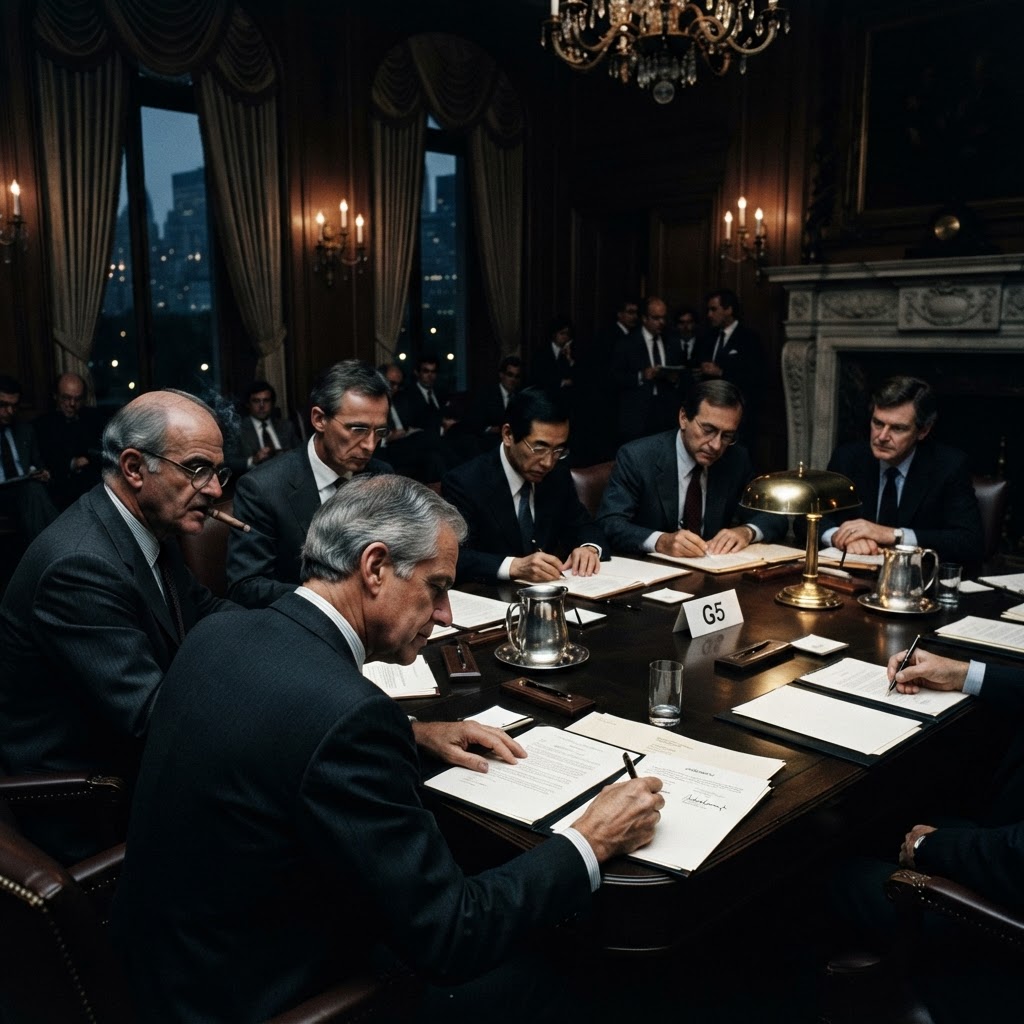
The Plaza Accord 1985: how the five largest economies devalued the dollar in a weekend
The secret agreement at the Plaza Hotel that coordinated the devaluation of the US dollar and saved American manufacturing
On September 22, 1985, the USA, Germany, Japan, France, and the UK agreed at the Plaza Hotel in New York to devalue the dollar. In two years, the dollar lost 40% against the yen and the mark.
The dollar too strong
In the early 1980s, Volcker's ultra-restrictive monetary policy had brought American rates to 20%. Global investors rushed to the dollar, which appreciated 50% between 1980 and 1985. The result was devastating for American industry: exports were too expensive, imports too cheap. The US trade deficit exploded.
The secret meeting
On September 22, 1985, the finance ministers and central bank governors of the G5 (USA, West Germany, Japan, France, UK) met secretly at the Plaza Hotel in New York. They reached an agreement: they would coordinate interventions in currency markets to bring the dollar down.
The result
The agreement was very effective: in two years, the dollar lost 40% against the yen and 50% against the German mark. For Japan, the yen revaluation was so brutal that it led to the expansionary monetary policy that fueled the 1980s bubble — the seed of the 1989 crash.
- Coordinated central bank policy agreements can move currency markets: the Plaza Accord demonstrated that coordinated intervention works.
- Every solution creates a new problem: the yen revaluation "saved" the USA but created the Japanese bubble.
- The dollar is a political weapon: its strength or weakness is managed based on American interests, not just markets.